A private manual for building wealth that survives you.
A Private Manual on Wealth
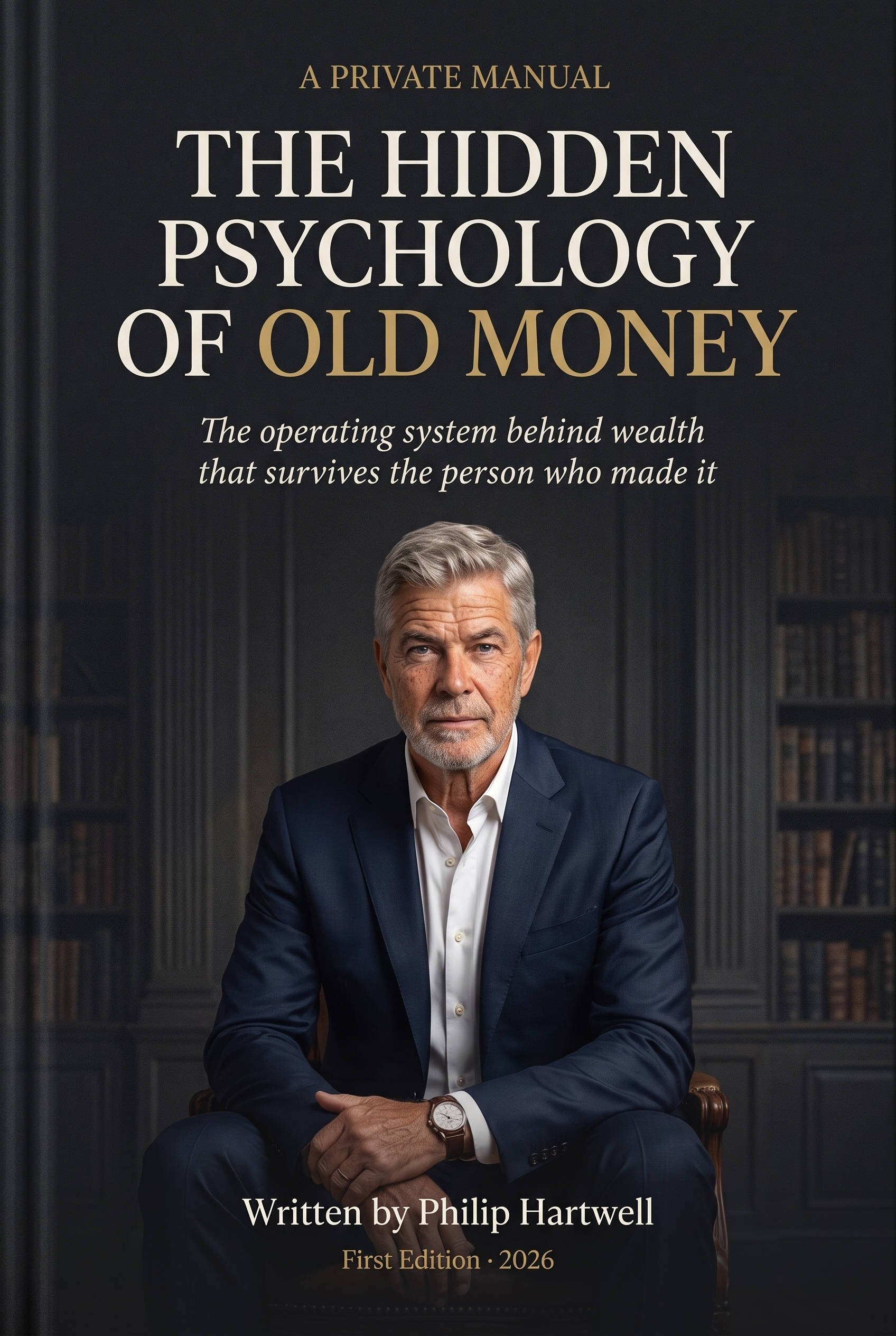
The Hidden
Psychology
of Old Money
The operating system behind wealth that survives the person who made it.
Everyone asks how much.
Almost nobody asks how long, under whose control, and surviving whose death.
Everyone asks how much.
Almost nobody asks how long.
Two families can have the same amount of money today and end up in completely different positions twenty or thirty years from now.
The difference is not simply income.
It is arrangement.
How money is structured.
How spending is controlled.
How decisions are made.
How reputation is protected.
How capital is allocated.
How ownership is transferred.
How systems survive the person who created them.
Wealth that lasts is not a class.
It is a method.
This is not a book
about getting rich.
It is about what happens after you learn how to make money.
The book examines the psychology, behavior, structures and defaults that allow wealth to become durable rather than temporary.
What You Will Learn
Five systems, examined in order.
- The Two Economies
- The Set Point
- The Narrow Room
- The Discipline of Not Acting
- The Second Price
- The Economics of Discretion
- Reputation Has a Duration
- Tables, Not Networks
- The Three Incomes
- Allocation Is the Whole Job
- The Three Ruins
- The Long Holder's Advantage
- Systems Outlive Intentions
- The Four Inheritances
Signature Frameworks
Five frameworks for thinking about durable wealth.
The Two Economies
Display economy versus durable economy.
The Set Point
Your lifestyle floor and the standard of living you assign yourself.
The Five Tables
Capital. Craft. Counsel. Continuity. The Gate.
The 90-Day Classification
C — Consumed. P — Partial. D — Durable.
The Allocation Handover
The transition from earning money to deciding where surplus goes.
The Book
A private manual, not a manifesto.
- Pages
- 78
- Chapters
- 14
- Parts
- 5
- Protocol
- 90-Day
First Edition · 2026
For people who want to build
something that lasts.
- Entrepreneurs
- Ambitious professionals
- Business owners
- People transitioning from earning to owning
- People interested in long-term wealth
- People interested in financial psychology and structure
- People who want to think beyond income
“How do you turn money into something that survives the person who made it?”
The answer is not simply making more.
It is learning how to operate differently.
The Offer
One book. No tiers.
The Hidden Psychology of Old Money
A Private Manual
- 78 pages
- First Edition · 2026
- Digital ebook
One book. One framework. A different way to think about wealth.
This is a digital ebook delivered instantly after purchase. It does not promise financial results — it presents a way of thinking about money that you apply at your own pace.
Questions
Frequently Asked
No. The book focuses on psychology, behavior, decision-making, capital structure, discretion and long-term thinking. It is not investment, tax or legal advice.
No. The principles are designed for people who want to build durable wealth, whether they are starting out, growing a business, or transitioning from earning to owning.
The First Edition is 78 pages.
A digital ebook delivered after purchase.
Philip Hartwell is the author of The Hidden Psychology of Old Money.
First Edition, 2026.
No. The book does not promise financial results. It presents frameworks for thinking about wealth, behavior, structure and long-term decision-making.
Build for longer than your lifetime.
The goal is not simply to make money.
The goal is to build something that knows how to keep it.